

Choosing the Right 3D Printing Material: A Guide to Chemical Resistance
When evaluating the chemical resistance of 3D printing materials, many users focus only on mechanical strength. However, understanding how a printed part interacts with oils, solvents, fuels, and cleaning agents is critical for real-world performance. This guide to the chemical resistance of 3D printing materials will help you select the right filament for demanding applications.
From manufacturing aids exposed to cutting fluids to laboratory equipment that requires frequent disinfection, the chemical resistance of 3D printing materials directly impacts part longevity and safety. A part may look perfect and feel strong, but without adequate chemical resistance, it can swell, crack, soften, or even dissolve when contacting common substances like alcohol, acetone, or hand lotion.
Why the Chemical Resistance of 3D Printing Materials Matters
The chemical resistance of 3D printing materials becomes essential in several key scenarios:
Jigs and fixtures exposed to oils, lubricants, or machining coolants
Containers or caps for cleaning products or industrial chemicals
Medical or lab devices that must survive repeated disinfection
Automotive or marine parts near fuel, diesel, or salt water
Outdoor equipment exposed to pesticides, de-icers, or bird droppings
If you ignore the chemical resistance of 3D printing materials, you risk unexpected failures, safety hazards, and costly reprints.

How popular 3D printing materials compare
Here’s a general guide to the chemical resistance of common filaments – always test with your specific chemical and conditions before final use.
PLA – Limited resistance
Resists: Dry handling, weak acids (e.g., vinegar) short‑term
Degrades quickly with: Alcohols, oils, bases, and most organic solvents
Note: PLA absorbs moisture and swells; not suitable for chemical exposure
PETG – Good all‑rounder
Resists: Diluted acids, many alcohols, oils, greases
Avoid: Strong bases (like sodium hydroxide), aromatic solvents, gasoline
Note: Better chemical resistance than PLA, but not for aggressive chemicals
ABS – Better for oils and fuels
Resists: Oils, greases, diluted acids, some fuels
Avoid: Strong solvents (acetone, MEK, ethyl acetate) – these dissolve ABS
Note: Acetone can be used for vapour smoothing, but that shows its vulnerability
ASA – Similar to ABS with better UV resistance
Resists: Oils, fuels, diluted acids, UV radiation
Avoid: Same strong solvents as ABS
Note: A great outdoor choice, but still avoids hydrocarbons like gasoline long‑term
Polycarbonate (PC) – Strong but sensitive
Resists: Oils, weak acids, aliphatic hydrocarbons
Avoid: Bases, amines, many solvents (e.g., acetone, toluene)
Note: High heat resistance but can stress‑crack with certain chemicals
Nylon (PA) – Good for oils but absorbs moisture
Resists: Oils, greases, fuels, weak alkalis
Degraded by: Strong acids, strong oxidizers, high humidity
Note: Chemical resistance changes dramatically with moisture content
Polypropylene (PP) – Excellent for many chemicals
Resists: Acids, bases, alcohols, many solvents, water
Avoid: Strong oxidizing agents, chlorinated solvents (long‑term)
Note: Very low surface energy – hard to glue or paint, but ideal for chemical containers
PVDF – Superior chemical resistance
Resists: Most acids, bases, solvents, halogens, oils
Very few exceptions: Fuming sulfuric acid, hot concentrated bases
Note: High‑end material for extreme environments – harder to print
TPU/TPE (flexible) – Depends on hardness
Resists: Oils, greases, many fuels (varies by type)
Avoid: Strong solvents, certain plasticisers
Note: Softer TPUs may swell in contact with hydrocarbons
Practical tips for chemical resistance success
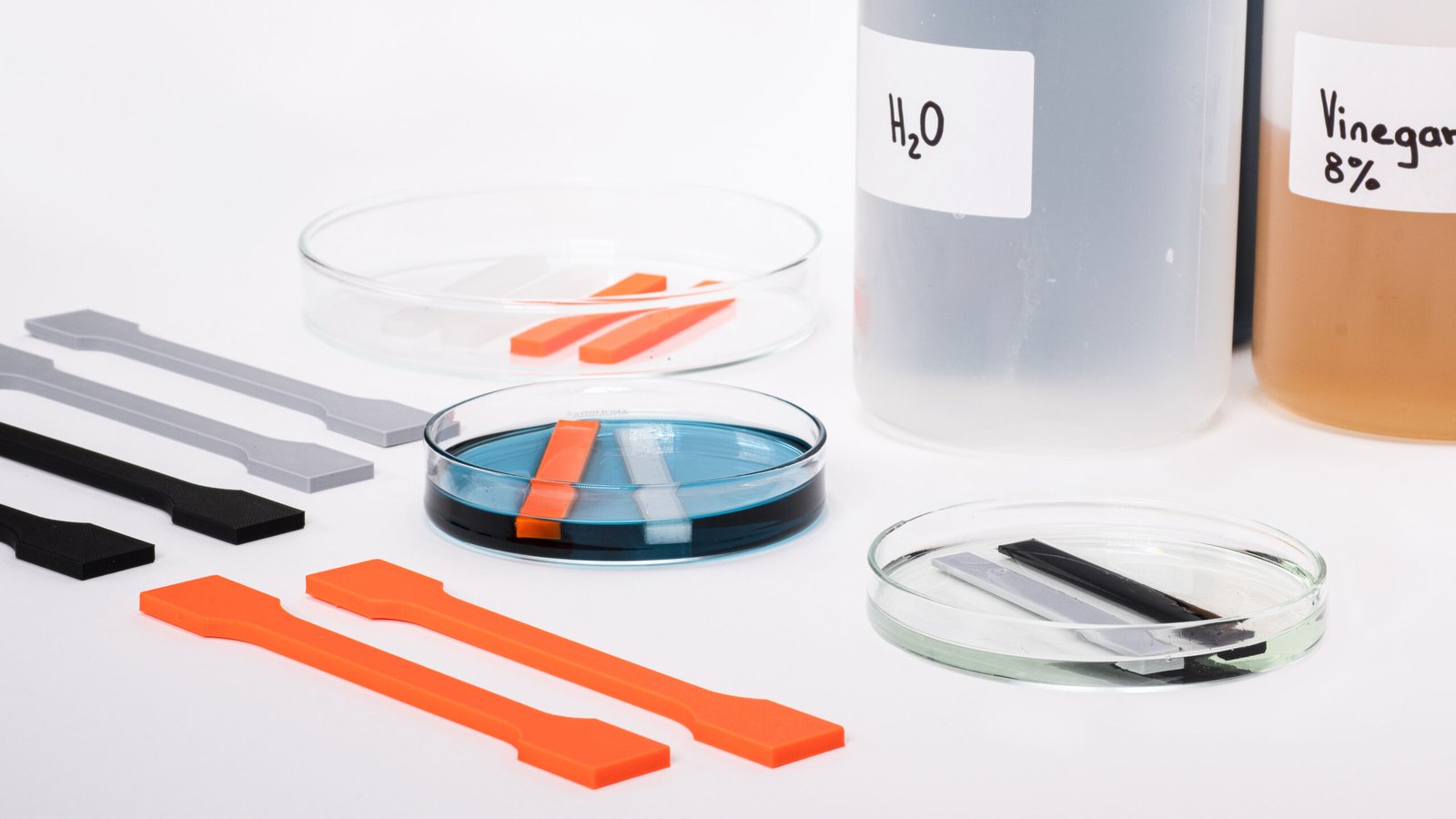
Always test first – Print a small sample and immerse it in the chemical for at least 24 hours. Measure changes in weight, dimensions, and hardness.
Consider post‑processing – Coatings (epoxy, polyurethane, or metal spray) can shield less‑resistant materials.
Don’t forget concentration and temperature – A chemical that’s fine at room temperature can destroy a part at 50°C. Highly concentrated acids or bases behave very differently from diluted solutions.
Check orientation and infill – Chemicals can seep through layer lines or infill gaps. For real containment, use 100% infill or multiple solid shells.
Look for validated data – Manufacturers sometimes publish chemical resistance charts. Use those as a starting point, but your own environment is the final test.
3D Printing Service Malaysia , 3D Printing service Singapore , 3D Printing service KL , 3D Printing service Selangor, 3D Scanning Malaysia
Why Partner with Projet ?
Selecting the right manufacturing technology is important—but choosing the right manufacturing partner is what truly drives success. Companies across the electronics, automotive, consumer products, aerospace, and medical industries trust Projet because we are more than just a supplier; we are a dedicated partner in their success.
Here’s what sets us apart:
A True One-Stop Solution
We provide a seamless experience by offering a comprehensive suite of manufacturing services under one roof. This integrated approach streamlines your supply chain and simplifies the journey from concept to a market-ready product.
Engineering Expertise You Can Count On
Our experienced engineering team acts as a dedicated extension of your own. We excel at solving complex manufacturing challenges and collaborate closely with you to optimize your designs for quality, cost-effectiveness, and manufacturability.
Flexible Production Volumes to Match Your Needs
Whether you require a single prototype or a high-volume production run, our manufacturing capabilities are designed to scale with your demands. We support your product’s entire lifecycle, from initial launch to full-scale production.
Rapid Turnaround for a Faster Time-to-Market
In today’s fast-paced market, speed is a crucial advantage. We deliver fast, transparent quotes and pride ourselves on our rapid turnaround times, helping you get your innovative products to market sooner.
3D Printing Services
Instant Price